Tampilkan postingan dengan label Western Europe. Tampilkan semua postingan

Cirencester Roman dig is 'history changing'

Excavations in Cirencester have unearthed one of the earliest burial sites ever found in Roman Britain. 

Archaeologists have uncovered more than 40 burials at the site [Credit: BBC]
The dig at the former Bridges Garage on Tetbury Road has uncovered over 40 burials and four cremations. 

Experts say it is the largest archaeological find in the town since the 1970s. 

Neil Holbrook, chief executive at Cotswold Archaeology, said he could not "underestimate the potential significance" of the discovery. 

Archaeologists said they were particularly excited by the discovery of a child's grave containing a pottery flagon, which could date to the early Roman period, between 70 AD and 120 AD. 

They said if the burial could be dated to this time, it could "challenge the current belief amongst archaeologists" that inhumation burials were not common practice until the later Roman period. 

"Whilst we are being cautious, we can't underestimate the potential significance this discovery could have for archaeologists in Britain," said Mr Holbrook. 

"Our specialists are working hard to provide further information to try to confirm the dating of this site." 

'Amazing so much has survived' 

A dig on the same site, carried out in the 1960s before the construction of the garage, unearthed 46 cremations, six burials and part of an inscribed tombstone dating from the 1st to 3rd Century. 

Project manager for Cotswold Archaeology, Cliff Bateman, said: "It is amazing that so much archaeology has survived the comprehensive building works." 

The former Bridges Garage site lies immediately outside the town, suggesting the burial site complied with Roman law that forbade burial within the town. 

Among items discovered were two bracelets made of green glass beads, jet beads, shale and copper alloy. 

Sonia Gravestock, of St James's Place Wealth Management which owns the site, said: "We were excited to discover that such a significant Roman site was located under our feet." 

The finds will now be conserved, and the skeletons examined at Cotswold Archaeology's head office. 

It is hoped that some of the finds will be put on show to the public in Cirencester's Corinium Museum. 

Source: BBC News Website [November 17, 2011]

Pictish 'seat of power' discovered in Aberdeenshire

An excavation has revealed a fortified early medieval settlement and unearthed significant artefacts which position a tiny Scottish village as a seat of major political power and influence. 

The Craw Stane with possible structures that may represent one or more buildings under excavation in the foreground (scale 2m) [Credit: University of Aberdeen]
Rare Late Roman pottery found during archaeological excavation at the site of a collection of eight unique Pictish symbol stones in Rhynie, has shed new light on this Aberdeenshire village, and provided fresh information on one of Britain’s most mysterious groups of people – the Picts. 

Earlier this year Dr Gordon Noble, from the University of Aberdeen, and Dr Meggen Gondek, from the University of Chester, led the Rhynie Environs Archaeological Project (REAP) in an excavation at the site where carved stones have been found south of the village. 

Between AD400-900 it is understood that the kingdoms of the Picts became some of the most powerful political groups in the north of Britain, but there is very little documented history and archaeological record about these mysterious people. 

The Craw Stane, with Tap O’ Noth hillfort on the left horizon [Credit: University of Aberdeen]
The symbol stones that the Picts left behind are acknowledged to provide a record of their identity, beliefs and lifestyle, although the elaborate carvings on these stones have not been translated and very little direct work has been carried out in relation to these stones, until now. 

The REAP team’s excavation near the Rhynie symbol stones – discovered between the 19th century and the 1970s – is one of the first large scale digs at this kind of site. 

During their excavation the team made some extraordinary discoveries, uncovering burnt material, stone, pottery, metalwork, glass and animal bone within a very substantial system of fortifications at the site. 

Student Joseph Tong excavating the palisade and post setting [Credit: University of Aberdeen]
Dr Gondek said: “Some of the material culture we uncovered is exceptional. This is one of the most significant finds of early medieval imported goods in the north of Britain. 

“The most remarkable were large fragments of a Roman amphora which was originally from the Eastern Mediterranean. This pottery was most likely to be used for transporting or storing wine, or possibly oil.” 

Many of the finds at Rhynie, such the small sherd of glass, which has been identified as a drinking bowl from the 6th or 7th-century AD, or the bronze pins and two amber beads, suggest it was a place of high status associated with fine dining and drinking. 

Amber beads [Credit: University of Aberdeen]
Dr Noble said: “This type of find is exceptionally rare in Britain, and is practically unheard of as far north as this. The type of artefacts we uncovered in Rhynie have only been found in more kingly centres such as Tintangel in Cornwall and Cadbury Castle in Somerset. The nearest site of similar importance in Scotland is Dumbarton Rock, an early royal site of the Britons of western Scotland, which is almost 200 miles away. 

“This means that what we thought was a backwater in this part of Britain may well be much more significant and that Rhynie can take its place as an important force in the power politics of early medieval Scotland.” 

Equally remarkable is the context of the finds, for they were found within the remains of what would have been an elaborate system of defensive enclosures including two deep ditches and a massive timber palisade and remains of further wooden structures including evidence for buildings. Very little is known about the early power centres of the Picts and Rhynie provides an exciting opportunity to find out more about how power was consolidated when the first kingdoms of Scotland were emerging. 

Student Robert Lang with spindle whorl from the possible building site near the Craw Stane at Rhynie [Credit: University of Aberdeen]
Dr Noble believes that the finds will affect how we understand the trade networks and political relationships during this period. The imported pottery is highly significant as it suggests Rhynie has political trading links with the kingdoms of the west. 

He added: “This sheds new light on a thorny issue because we have so little historical documentation about the Picts. We don’t know how they existed or why they disappeared. We have snippets of stories from the early medieval writers through which that we learn that they’re politically active. But with this excavation we are getting the real physical evidence of who they were as a people – we just have to keep digging to find out more.” 

Source: University of Aberdeen [November 16, 2011]

More on Bronze Age burial site excavated on Dartmoor

Relics discovered at a recent Dartmoor archaeological dig have this week been described as among the most important prehistoric finds to be unearthed anywhere in Britain in the past 100 years. 

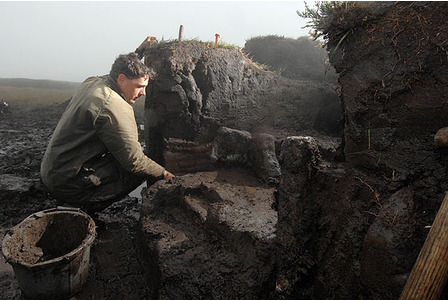
Dr Andy Jones and Dr Ralph Fyfe at the burial site on Dartmoor [Credit: This is Devon]
The excavation, which was reported exclusively in the Western Morning News in August, has revealed numerous 4,000-year-old artefacts, including cremated human bone. 

Scientists working at a special laboratory in Wiltshire have been sifting through items found in the ancient stone cist in an exercise known as a “micro-excavation” – and now say that the combination and variety of relics could give a unique glimpse into what life was like in South West England some 40 centuries ago. 

Cists are stone-built chests which were used for the burial of cremations or inhumations, and are found in some highland parts of the Westcountry and elsewhere – but rarely with their original contents remaining in any kind of state, let alone vaguely intact. 

Cremated bone discovered at the White Horse Hill excavation [Credit: This is Devon]
Jane Marchand, senior archaeologist for Dartmoor National Park Authority and project manager of the Whitehorse Hill dig, told the WMN: “This is a most unusual and fascinating glimpse into what an early Bronze Age ‘grave goods assemblage’ on Dartmoor might have looked like when it was buried, including the personal possessions of people living on the moor around 4,000 years ago. The find is unusual because of how well preserved the items are and also the many types of organic material – all of which means we get a huge amount of information.” 

Mrs Marchand said that archaeologists had found two bag-like objects – one made of leather and one created from a woven material. 

“It was immediately evident that micro-excavation in controlled conditions was essential as, once exposed, the organic remains were very vulnerable.” 

Dr Ralph Fyfe, of Plymouth University, works at the burial site on Dartmoor before it was moved to a laboratory [Credit: This is Devon]
The entire deposit, including the granite base stone, has now been sent off for further testing. Mrs Marchand said she and her team were hugely excited by the information that could eventually be revealed. 

“For example,” she said, “we can find out what animal leather they were using – we have various specialists coming down to look at the skin and fur who should be able to identify the animals. At the moment we just don’t know if they belong to wild or domesticated animals. They could be cattle, deer, wolf or even aurochs.” 

Archaeologists are also excited by the number of beads found in the burial cist: “Their presence could mean it was a high status burial that you’d normally only see in Wessex or Orkney,” said Mrs Marchand. “There were a number of amber beads which probably came from the Baltic – and that must have meant they were doing long-distance trading 4,000 years ago.” 

A close-up of the beads found under a woven object [Credit: This is Devon]
Archaeologists unearthed the relics three days into the August dig which had been staged because the entire cist, located nearly 2,000 feet above sea level, was in danger of collapsing due to peat erosion. 

The cist was excavated on land owned by the Duchy of Cornwall by archaeologists from Cornwall Council’s historic environment projects team, with assistance from English Heritage and Plymouth University specialists. 

A programme of analysis will now follow, to examine the peat surrounding the cist. Studies of pollen, other plant remains and radio carbon dating will provide evidence of vegetation and climate at the time of the burial. 

The national park authority plans to rebuild the cist and reinstate it in exactly the place where it was found. 

Source: This is Devon [November 16, 2011]

Human bones in Gloucester museum 'not from Stone Age' after all

A set of human bones at Gloucester museum, always believed to be from the Stone Age, are now thought to be only about 500 years old. 

The box contained 262 human bone fragments, including complete arm bones [Credit: BBC]
The remains, which have been in storage for more than a century, were labelled "from a long barrow". 

Long barrows are ancient Neolithic burial sites from about 6,000 years ago, but radio carbon dating has shown the bones date to between 1523 and 1799. 

Gloucester museum's archaeology curator, David Rice, said he was "surprised" by the results. 

The box of bones, containing partial remains from at least six individuals, was first officially recorded in a stock take, at what is now Gloucester City Museum and Art Gallery, in the 1950s. 

An entry in a ledger from the time reads: "Human bones. One skull, calvarium [upper part of skull] only and part of a lower jaw, together with a large number of bones of several individuals, from a long barrow - site unknown, donor unknown". 

'Prehistoric site' 

The box contained 262 human bone fragments, ranging from complete arm bones to tiny skull fragments. 

The bones have been in storage for more than a century [Credit: BBC]
Mr Rice said: "The bones had been in storage in a cardboard box. All we had to go on was what was written down in the books." 

The museum decided to send the relics away for testing, using modern techniques. 

Archaeologist Emily Trapnell from Bournemouth University, who carried out the tests on one of the bones from an adolescent, said: "Initially the bones seemed to fit the description of what you'd expect to find from a Neolithic long barrow. 

"The remains were very fragmented, and there was also some animal bone amongst them." 

'Definitely a shock' 

Ms Trapnell said the intention had been to try to identify the geographical location of the long barrow they came from, by testing soil from the bones and using published literature to try to find a match. 

"However after radio carbon dating we found the bones date from between 1523 and 1799 so they are actually modern rather than Neolithic. 

"It was definitely a shock," she said. 

The analysis also suggested that at least one of the skeletons was from a different site to the other bones, but where, exactly, is still unknown. 

Tests have been carried out on the bones at Bournemouth University [Credit: BBC]
Mr Rice said: "Usually we believe everything that's written on a label in a museum, but it seems that something's happened here." 

There are now various theories which could explain the date being a lot more recent than expected. 

One idea is that whoever dug them up wrongly thought they were digging in a long barrow. 

'Smoked big pipes' 

"Or it could be the bones are contaminated," added Mr Rice. 

"These old curators, they all smoked big pipes and passed things around amongst each other, and it could be that some of their material has rubbed off [which could have produced an error in the radio carbon dating]." 

The museum said the bones would now have to be re-labelled, and more detailed tests would be carried out if funding could be secured, but there was no guarantee the bones would go on show to the public. 

"You have to be very respectful," said Mr Rice. "You have to remember these are real people. 

"We have got a human remains policy that lays out exactly how they can be seen, how they can be handled and how they should be treated. 

"If they're proved to be modern and of no use to the scientific community then we probably owe it to them to rebury them. 

"But if they are prehistoric and pagan, to give them a Christian burial ceremony would perhaps be the wrong thing to do," added Mr Rice. 

Source: BBC News Website [November 16, 2011]

Lost Norman town found in Ireland

The astonishing story of a Norman town lost for centuries is being brought back to life.  Cutting edge LIDAR technology, deployed by armed forces to detect underground bunkers, has uncovered the streets, towns and dwellings of an early Norman settlement known as Newtown just outside Thomastown. 

A bit of surviving stonework from the ruined abbey [Credit: Bensozia]
Within 15 miles of Kilkenny, the medieval settlement has been the focus of a recent archaeological dig backed up by the latest technology to tell the story of what has been described as ’Kilkenny’s Pompeii.’ 

Newtown, which contains the site of St Nicholas Church, has long been known as a site of historical importance. Apart from local legend, the site next to Belmore House has been earmarked as one of historical importance dating back over 100 years when it first appeared on an ordnance survey map. 

Lidar image of Newtown Jerpoint [Credit: Jerpoint Park]
Recent discoveries with the help of technology, and also the unearthing of a tombstone for a 13th century monk called Thomas Poer, has shined a spotlight on medieval life at the settlement. 

A conservation plan commissioned by The Heritage Council has described the site as one of exceptional significance - highlighting the fact that the site is a rare surviving example of an abandoned medieval town, complete with standing remains and with quality documentation. 

Landowner Joe O’Connell, the proprietor of Jerpoint Park which is the home of Belmore House, believes that the site has huge tourism potential for Kilkenny. He will attend the next meeting of Kilkenny County Council outlining his aspirations for the future development of the site. 

An artist's impression of the town in the 12th century [Credit: Uto Hogerzeil]
The story of Newtown dates back to the 1200’s when its size was comparable to half of the city of Kilkenny. But within two centuries, the town simply vanished off the map apart from St Nicholas Church and graveyard, which remained as a parish church for the area. 

The closure of nearby Jerpoint Abbey in the mid 14th Century by King Henry VIII sealed the fate of Newtown. 

But now, thanks to the work of the Heritage Council and Cóilín ÓDrisceoil of Kilkenny Archaeology plus the support of Kilkenny Leader, Joe and his wife Maeve are determined that the story of Newtown be told and experienced for future generations. 

Source: Kilkenny People [November 09, 2011]

No second chamber found at Newgrange

The technology used in an attempt to find out whether a second passage tomb, which may also be aligned with a solstice event, exists at Newgrange had proved its worth during experimentation by a Slovakian team of scientists who visited the Boyne Valley, an Irish archaeologist said this week. 

Megalithic Passage Tomb in Newgrange, Ireland [Credit: Bing, public domain]
Dr Conor Brady, archaeologist and lecturer at Dundalk Institute of Technology, who lives at Slane, said that while there would be no "dramatic announcements" about discovery of a second chamber at Newgrange at this stage, the microgravitational technology used in the experiments had proven valuable to archaeologists and scientists. 

The possibility that Newgrange could have a second passage tomb, which may also be aligned with a solstice event, was being explored by a team of Irish and Slovakians archaeologists using ground-breaking technology. 

Already part of the Brú na Bóinne World Heritage Site, Newgrange is one of the most popular tourist attractions in Ireland and if a second chamber was uncovered it would add to its already global iconic status. 

Newgrange is synonymous with sunrise on the winter solstice but the possibility that it has another as yet unknown chamber is not being ruled out. 

Dr Brady said this week that while the weather conditions encountered by the team at Newgrange created difficulty in the use of the highly-sensitive equipment, it had nevertheless shown that "it works". 

The purpose of the microgravitational equipment was to detect underground cavities. The microgravity meter responds to variations in density in the ground beneath it. 

Source: The Meath Chronicle [November 09, 2011]

Stone Age paintings found in Swabia

Archaeologists have found cave paintings thought to be Central Europe's oldest such artwork in Baden-Württemberg’s Swabian Alps. 

Archaeologists examine the recently discovered cave paintings [Credit: DPA]
They found four painted stones from the cave Hohle Fels near Schelklingen, although the meaning of the red-brown spots is still a mystery. 

The stone paintings, thought to be 15,000 years old, are being displayed at a special exhibition at the University of Tübingen’s museum. 

The spots don’t seem particularly artistic at first glance. But they are important because they represent the first time such old paintings have been found in Central Europe, although similar work has been seen in France and Spain. 

Hohle Fels 2009. a) a painted fragment of limestone, perhaps originating from the wall of the cave. b) a limestone cobble with parallel lines of red dots [Credit: Marina Malina, University of Tübingen]
The stones at Hohe Fels appear to have been painted with a mixture of red chalk and lime, with water from the cave, said excavation technician Maria Malina. 

“These spots are anything but accidental,” said archaeologist Nicholas Conard who assisted on the find. “It is quite clear that they have relevant content.” 

What it all really means remains unclear. There is speculation the spots could refer to shamanism or be a menstrual calendar of sorts. 

Hohle Fels has been a magnet for archaeologists in recent years after researchers working there found a Venus figure and flutes thought to be 40,000 years old. 

Source: The Local [November 09, 2011]

University of Salford to dig Manchester boroughs

The University of Salford has announced a four year archaeology project which will see 9,000 people involved in digs. 

The digs will include a range of buildings, from the medieval to those of the Industrial Revolution [Credit: BBC]
Dig Greater Manchester, which will also include a study in Blackburn, will see volunteers work alongside experts at 11 sites. 

Brian Grimsditch, who works at the university's Centre for Applied Archaeology, said it was "one of the biggest projects in the country". 

"It will be a wonderful way for people to learn about the history," he said. 

The project, funded by the Association of Greater Manchester Authorities, is intended to be a learning experience for everyone involved, with workshops being held to equip volunteers with archaeology skills. 

It will see one dig take place in each of the 10 Greater Manchester boroughs, with one extra study taking place outside the area in Blackburn. 

The specific sites of the excavations have yet to be announced, but a university spokesman said they would "range from the medieval to industrial mills". 

About 6,000 school and college students will take part in the digs, with the other 3,000 volunteer places being offered to members of the local communities where the digs will take place. 

The digs will be accompanied by a series of lectures and presentations on the local history and archaeology of the boroughs. 

The whole project will finish with a conference that will present an overview of all the archaeological findings. 

Manchester City Council's Paul Murphy said it was "a fantastic project that will get thousands of young people across Greater Manchester involved in something hands-on, educational and exciting". 

"It will also provide them with a vital opportunity to learn about the history of their local community and obtain new skills that they may want to develop into a future career," he said. 

Norman Redhead, Greater Manchester County Archaeologist said the project would "build on the long tradition of community engagement with the area's archaeology". 

"I suspect local communities will be amazed at what they uncover on their doorstep," he said. 

"We know from previous community digs that the people of Greater Manchester have a tremendous enthusiasm for getting involved with their local heritage. 

"I can't wait to see what the project unearths." 

Source: BBC News Website [November 08, 2011]

Liverpool waterfront development prompts UNESCO visit

UNESCO is visiting Liverpool next week to consider whether the city's waterfront should lose its world heritage status. 

The Three Graces, with cranes at work on the nearby waterfront construction site [Credit: David Sillitoe/Guardian]
The UN body is sending a monitoring mission to the city because it is concerned about the impact of Peel Holdings' £5.5bn Liverpool Waters scheme. 

Liverpool's world heritage site takes in the elegant Edwardian "three graces" – the Royal Liver, Cunard and Port of Liverpool buildings – which have defined the view from the river Mersey for almost a century. 

Earlier this year, an independent report commissioned by English Heritage warned the waterfront could lose its world heritage status if the project to regenerate the city's northern docklands is approved. 

The three-day mission will arrive on 14 November and report its findings by 23 December at the latest. 

Heritage campaigner Wayne Colquhoun, who was instrumental in persuading Unesco to send its inspectors, said he hoped they would not repeat "past mistakes". 

Author: Helen Carter | Source: The Guardian/UK [November 07, 2011]

DNA provides new insights into cave paintings of horses

An international team of researchers has used ancient DNA to shed new light on the realism of horses depicted in prehistoric cave paintings. 

A horse from the "Panel of the Chinese Horses" from the Lascaux Cave [Credit: N. Aujoulat, Ministère de la Culture et de la Communication, France]
The team, which includes researchers from the University of York, has found that all the colour variations seen in Paleolithic cave paintings – including distinctive ‘leopard’ spotting - existed in pre-domestic horse populations, lending weight to the argument that the artists were reflecting their natural environment. 

The study, published in Proceedings of the National Academy of Sciences (PNAS) today, is also the first to produce evidence for white spotted phenotypes in pre-domestic horses. Previous ancient DNA studies have only produced evidence for bay and black horses. 

Archaeologists have long debated whether works of art from the Paleolithic period, particularly cave paintings, are reflections of the natural environment or have deeper abstract or symbolic meanings. 

This is particularly true of the cave painting “The Dappled Horses of Pech-Merle” in France, which dates back more than 25,000 years and clearly depicts white horses with dark spots. 

The dappled horses’ spotted coat pattern bears a strong resemblance to a pattern known as ‘leopard’ in modern horses. However, as some researchers believed a spotted coat phenotype unlikely at this time, pre-historians have often argued for more complex explanations, suggesting the spotted pattern was in some way symbolic or abstract. 

Researchers from the UK, Germany, USA, Spain, Russia and Mexico genotyped and analysed nine coat-colour loci in 31 pre-domestic horses dating back as far as 35,000 years ago from Siberia, Eastern and Western Europe and the Iberian Peninsula. This involved analysing bones and teeth specimens from 15 locations. 

They found that four Pleistocene and two Copper Age samples from Western and Eastern Europe shared a gene associated with leopard spotting, providing the first evidence that spotted horses existed at this time. 

In addition, 18 horses had a bay coat colour and seven were black, meaning that all colour phenotypes distinguishable in cave paintings – bay, black and spotted – existed in pre-domestic horse populations.  

Professor Michi Hofreiter, from the Department of Biology at the University of York, said: “Our results suggest that, at least for wild horses, Paleolithic cave paintings, including the remarkable depictions of spotted horses, were closely rooted in the real-life appearance of animals.   

“While previous DNA studies have produced evidence for bay and black horses, our study has demonstrated that the leopard complex spotting phenotype was also already present in ancient horses and was accurately depicted by their human contemporaries nearly 25,000 years ago.   

“Our findings lend support to hypotheses that argue that cave paintings constitute reflections of the natural environment of humans at the time and may contain less of a symbolic or transcendental connotation than often assumed.” 

The data and laboratory work were led by Dr Melanie Pruvost, from the Department of Evolutionary Genetics at the Leibniz Institute for Zoo and Wildlife Research and the Department of Natural Sciences at the German Archaeological Institute, both in Berlin. The results were replicated in laboratories at the University of York. 

Horses from the Hillaire Chamber, Chauvet Cave [Credit: French Ministry of Culture and Communication, Regional Direction for Cultural Affairs, Rhône-Alpes region, Regional Department of Archaeology]
Dr Pruvost said: “We are just starting to have the genetic tools to access the appearance of past animals and there are still a lot of question marks and phenotypes for which the genetic process has not yet been described. However, we can already see that this kind of study will greatly improve our knowledge about the past. Knowing that leopard spotting horses were present during the Pleistocene in Europe provides new arguments or insights for archaeologists to interpret cave arts.” 

Dr Arne Ludwig, from the Leibniz Institute for Zoo and Wildlife Research in Berlin, added: “Although taken as a whole, images of horses are often quite rudimentary in their execution, some detailed representations, from both Western Europe and the Ural mountains, are realistic enough to at least potentially represent the actual appearance of the animals when alive. 

“In these cases, attributes of coat colours may also have been depicted with deliberate naturalism, emphasizing colours or patterns that characterised contemporary horses.”  

Exact numbers of Upper Paleolithic sites with animal depictions are uncertain because of ongoing debates about the taxonomic identification of some images and dating. However, art of this period has been identified in at least 40 sites in the Dordogne-Périgord region, a similar number in coastal Cantabria and around a dozen sites in both the Ardèche and Ariège regions. 

Where animal species can be confidently identified, horses are depicted at the majority of these sites. 

Professor Terry O’Connor from the University of York’s Department of Archaeology was involved in the interpretation of the results. He said: “Representations of animals from the Paleolithic period have the potential to provide first-hand insights into the physical environment that humans encountered thousands of years ago. However, the motivation behind, and therefore the degree of realism in these depictions is hotly debated. 

“The depictions of horses at Pech-Merle in particular have generated a great deal of debate. The spotted horses are featured in a frieze which includes hand outlines and abstract patterns of spots. The juxtaposition of elements has raised the question of whether the spotted pattern is in some way symbolic or abstract, especially since many researchers considered a spotted coat phenotype unlikely for Paleolithic horses. 

“However, our research removes the need for any symbolic explanation of the horses. People drew what they saw, and that gives us greater confidence in understanding Paleolithic depictions of other species as naturalistic illustrations.” 

Leopard complex spotting in modern horses is characterised by white spotting patterns that range from horses having a few white spots on the rump to horses that are almost completely white. The white area of these horses can also have pigmented oval spots known as ‘leopard spots’. 

Dr. Monika Reissmann, from Humboldt University’s Department for Crop and Animal Sciences, explained: “This phenotype was in great demand during the Baroque Age. But in the following centuries the leopard complex phenotype went out of fashion and became very rare. Today leopard complex is a popular phenotype in several horse breeds including Knabstrupper, Appaloosa and Noriker and breeding efforts have intensified again because there is a growing interest in the restoration of these horses.” 

The fact that four out of 10 of the Western European horses from the Pleistocene had a genotype indicative of the leopard complex phenotype, suggests that this phenotype was not rare in Western Europe during this period. 

However, bay seems to have been the most common colour phenotype in pre-domestic times with 18 out of the 31 samples having bay genotypes. This is also the most commonly painted phenotype in the Paeolithic period. 

Source: University of York [November 07, 2011]
Related Posts Plugin for WordPress, Blogger...