Tampilkan postingan dengan label UK. Tampilkan semua postingan

Cirencester Roman dig is 'history changing'

Excavations in Cirencester have unearthed one of the earliest burial sites ever found in Roman Britain. 

Archaeologists have uncovered more than 40 burials at the site [Credit: BBC]
The dig at the former Bridges Garage on Tetbury Road has uncovered over 40 burials and four cremations. 

Experts say it is the largest archaeological find in the town since the 1970s. 

Neil Holbrook, chief executive at Cotswold Archaeology, said he could not "underestimate the potential significance" of the discovery. 

Archaeologists said they were particularly excited by the discovery of a child's grave containing a pottery flagon, which could date to the early Roman period, between 70 AD and 120 AD. 

They said if the burial could be dated to this time, it could "challenge the current belief amongst archaeologists" that inhumation burials were not common practice until the later Roman period. 

"Whilst we are being cautious, we can't underestimate the potential significance this discovery could have for archaeologists in Britain," said Mr Holbrook. 

"Our specialists are working hard to provide further information to try to confirm the dating of this site." 

'Amazing so much has survived' 

A dig on the same site, carried out in the 1960s before the construction of the garage, unearthed 46 cremations, six burials and part of an inscribed tombstone dating from the 1st to 3rd Century. 

Project manager for Cotswold Archaeology, Cliff Bateman, said: "It is amazing that so much archaeology has survived the comprehensive building works." 

The former Bridges Garage site lies immediately outside the town, suggesting the burial site complied with Roman law that forbade burial within the town. 

Among items discovered were two bracelets made of green glass beads, jet beads, shale and copper alloy. 

Sonia Gravestock, of St James's Place Wealth Management which owns the site, said: "We were excited to discover that such a significant Roman site was located under our feet." 

The finds will now be conserved, and the skeletons examined at Cotswold Archaeology's head office. 

It is hoped that some of the finds will be put on show to the public in Cirencester's Corinium Museum. 

Source: BBC News Website [November 17, 2011]

Pictish 'seat of power' discovered in Aberdeenshire

An excavation has revealed a fortified early medieval settlement and unearthed significant artefacts which position a tiny Scottish village as a seat of major political power and influence. 

The Craw Stane with possible structures that may represent one or more buildings under excavation in the foreground (scale 2m) [Credit: University of Aberdeen]
Rare Late Roman pottery found during archaeological excavation at the site of a collection of eight unique Pictish symbol stones in Rhynie, has shed new light on this Aberdeenshire village, and provided fresh information on one of Britain’s most mysterious groups of people – the Picts. 

Earlier this year Dr Gordon Noble, from the University of Aberdeen, and Dr Meggen Gondek, from the University of Chester, led the Rhynie Environs Archaeological Project (REAP) in an excavation at the site where carved stones have been found south of the village. 

Between AD400-900 it is understood that the kingdoms of the Picts became some of the most powerful political groups in the north of Britain, but there is very little documented history and archaeological record about these mysterious people. 

The Craw Stane, with Tap O’ Noth hillfort on the left horizon [Credit: University of Aberdeen]
The symbol stones that the Picts left behind are acknowledged to provide a record of their identity, beliefs and lifestyle, although the elaborate carvings on these stones have not been translated and very little direct work has been carried out in relation to these stones, until now. 

The REAP team’s excavation near the Rhynie symbol stones – discovered between the 19th century and the 1970s – is one of the first large scale digs at this kind of site. 

During their excavation the team made some extraordinary discoveries, uncovering burnt material, stone, pottery, metalwork, glass and animal bone within a very substantial system of fortifications at the site. 

Student Joseph Tong excavating the palisade and post setting [Credit: University of Aberdeen]
Dr Gondek said: “Some of the material culture we uncovered is exceptional. This is one of the most significant finds of early medieval imported goods in the north of Britain. 

“The most remarkable were large fragments of a Roman amphora which was originally from the Eastern Mediterranean. This pottery was most likely to be used for transporting or storing wine, or possibly oil.” 

Many of the finds at Rhynie, such the small sherd of glass, which has been identified as a drinking bowl from the 6th or 7th-century AD, or the bronze pins and two amber beads, suggest it was a place of high status associated with fine dining and drinking. 

Amber beads [Credit: University of Aberdeen]
Dr Noble said: “This type of find is exceptionally rare in Britain, and is practically unheard of as far north as this. The type of artefacts we uncovered in Rhynie have only been found in more kingly centres such as Tintangel in Cornwall and Cadbury Castle in Somerset. The nearest site of similar importance in Scotland is Dumbarton Rock, an early royal site of the Britons of western Scotland, which is almost 200 miles away. 

“This means that what we thought was a backwater in this part of Britain may well be much more significant and that Rhynie can take its place as an important force in the power politics of early medieval Scotland.” 

Equally remarkable is the context of the finds, for they were found within the remains of what would have been an elaborate system of defensive enclosures including two deep ditches and a massive timber palisade and remains of further wooden structures including evidence for buildings. Very little is known about the early power centres of the Picts and Rhynie provides an exciting opportunity to find out more about how power was consolidated when the first kingdoms of Scotland were emerging. 

Student Robert Lang with spindle whorl from the possible building site near the Craw Stane at Rhynie [Credit: University of Aberdeen]
Dr Noble believes that the finds will affect how we understand the trade networks and political relationships during this period. The imported pottery is highly significant as it suggests Rhynie has political trading links with the kingdoms of the west. 

He added: “This sheds new light on a thorny issue because we have so little historical documentation about the Picts. We don’t know how they existed or why they disappeared. We have snippets of stories from the early medieval writers through which that we learn that they’re politically active. But with this excavation we are getting the real physical evidence of who they were as a people – we just have to keep digging to find out more.” 

Source: University of Aberdeen [November 16, 2011]

More on Bronze Age burial site excavated on Dartmoor

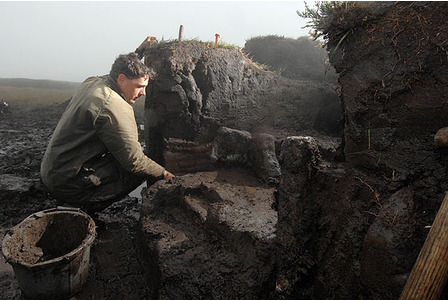
Relics discovered at a recent Dartmoor archaeological dig have this week been described as among the most important prehistoric finds to be unearthed anywhere in Britain in the past 100 years. 

Dr Andy Jones and Dr Ralph Fyfe at the burial site on Dartmoor [Credit: This is Devon]
The excavation, which was reported exclusively in the Western Morning News in August, has revealed numerous 4,000-year-old artefacts, including cremated human bone. 

Scientists working at a special laboratory in Wiltshire have been sifting through items found in the ancient stone cist in an exercise known as a “micro-excavation” – and now say that the combination and variety of relics could give a unique glimpse into what life was like in South West England some 40 centuries ago. 

Cists are stone-built chests which were used for the burial of cremations or inhumations, and are found in some highland parts of the Westcountry and elsewhere – but rarely with their original contents remaining in any kind of state, let alone vaguely intact. 

Cremated bone discovered at the White Horse Hill excavation [Credit: This is Devon]
Jane Marchand, senior archaeologist for Dartmoor National Park Authority and project manager of the Whitehorse Hill dig, told the WMN: “This is a most unusual and fascinating glimpse into what an early Bronze Age ‘grave goods assemblage’ on Dartmoor might have looked like when it was buried, including the personal possessions of people living on the moor around 4,000 years ago. The find is unusual because of how well preserved the items are and also the many types of organic material – all of which means we get a huge amount of information.” 

Mrs Marchand said that archaeologists had found two bag-like objects – one made of leather and one created from a woven material. 

“It was immediately evident that micro-excavation in controlled conditions was essential as, once exposed, the organic remains were very vulnerable.” 

Dr Ralph Fyfe, of Plymouth University, works at the burial site on Dartmoor before it was moved to a laboratory [Credit: This is Devon]
The entire deposit, including the granite base stone, has now been sent off for further testing. Mrs Marchand said she and her team were hugely excited by the information that could eventually be revealed. 

“For example,” she said, “we can find out what animal leather they were using – we have various specialists coming down to look at the skin and fur who should be able to identify the animals. At the moment we just don’t know if they belong to wild or domesticated animals. They could be cattle, deer, wolf or even aurochs.” 

Archaeologists are also excited by the number of beads found in the burial cist: “Their presence could mean it was a high status burial that you’d normally only see in Wessex or Orkney,” said Mrs Marchand. “There were a number of amber beads which probably came from the Baltic – and that must have meant they were doing long-distance trading 4,000 years ago.” 

A close-up of the beads found under a woven object [Credit: This is Devon]
Archaeologists unearthed the relics three days into the August dig which had been staged because the entire cist, located nearly 2,000 feet above sea level, was in danger of collapsing due to peat erosion. 

The cist was excavated on land owned by the Duchy of Cornwall by archaeologists from Cornwall Council’s historic environment projects team, with assistance from English Heritage and Plymouth University specialists. 

A programme of analysis will now follow, to examine the peat surrounding the cist. Studies of pollen, other plant remains and radio carbon dating will provide evidence of vegetation and climate at the time of the burial. 

The national park authority plans to rebuild the cist and reinstate it in exactly the place where it was found. 

Source: This is Devon [November 16, 2011]

Human bones in Gloucester museum 'not from Stone Age' after all

A set of human bones at Gloucester museum, always believed to be from the Stone Age, are now thought to be only about 500 years old. 

The box contained 262 human bone fragments, including complete arm bones [Credit: BBC]
The remains, which have been in storage for more than a century, were labelled "from a long barrow". 

Long barrows are ancient Neolithic burial sites from about 6,000 years ago, but radio carbon dating has shown the bones date to between 1523 and 1799. 

Gloucester museum's archaeology curator, David Rice, said he was "surprised" by the results. 

The box of bones, containing partial remains from at least six individuals, was first officially recorded in a stock take, at what is now Gloucester City Museum and Art Gallery, in the 1950s. 

An entry in a ledger from the time reads: "Human bones. One skull, calvarium [upper part of skull] only and part of a lower jaw, together with a large number of bones of several individuals, from a long barrow - site unknown, donor unknown". 

'Prehistoric site' 

The box contained 262 human bone fragments, ranging from complete arm bones to tiny skull fragments. 

The bones have been in storage for more than a century [Credit: BBC]
Mr Rice said: "The bones had been in storage in a cardboard box. All we had to go on was what was written down in the books." 

The museum decided to send the relics away for testing, using modern techniques. 

Archaeologist Emily Trapnell from Bournemouth University, who carried out the tests on one of the bones from an adolescent, said: "Initially the bones seemed to fit the description of what you'd expect to find from a Neolithic long barrow. 

"The remains were very fragmented, and there was also some animal bone amongst them." 

'Definitely a shock' 

Ms Trapnell said the intention had been to try to identify the geographical location of the long barrow they came from, by testing soil from the bones and using published literature to try to find a match. 

"However after radio carbon dating we found the bones date from between 1523 and 1799 so they are actually modern rather than Neolithic. 

"It was definitely a shock," she said. 

The analysis also suggested that at least one of the skeletons was from a different site to the other bones, but where, exactly, is still unknown. 

Tests have been carried out on the bones at Bournemouth University [Credit: BBC]
Mr Rice said: "Usually we believe everything that's written on a label in a museum, but it seems that something's happened here." 

There are now various theories which could explain the date being a lot more recent than expected. 

One idea is that whoever dug them up wrongly thought they were digging in a long barrow. 

'Smoked big pipes' 

"Or it could be the bones are contaminated," added Mr Rice. 

"These old curators, they all smoked big pipes and passed things around amongst each other, and it could be that some of their material has rubbed off [which could have produced an error in the radio carbon dating]." 

The museum said the bones would now have to be re-labelled, and more detailed tests would be carried out if funding could be secured, but there was no guarantee the bones would go on show to the public. 

"You have to be very respectful," said Mr Rice. "You have to remember these are real people. 

"We have got a human remains policy that lays out exactly how they can be seen, how they can be handled and how they should be treated. 

"If they're proved to be modern and of no use to the scientific community then we probably owe it to them to rebury them. 

"But if they are prehistoric and pagan, to give them a Christian burial ceremony would perhaps be the wrong thing to do," added Mr Rice. 

Source: BBC News Website [November 16, 2011]

New gallery reveals skill of Neolithic Chinese potters at The Oriental Museum in Durham

Two years ago, Chinese art-historian Xiaoxin Li began an investigation into hundreds of ceramics. 

The Oriental Museum is the only collection in the region specifically dedicated to the art and archaeology of the Orient [Credit: Culture24]
His inquisition surveyed models made for burial in ancient tombs, porcelain created for the Imperial court thousands of years ago, an iron horse and a range of incredible carved jade ornaments. 

Now they've gone on show in a new gallery devoted to Chinese art and archaeology, taking over an entire floor of Durham University’s Oriental Museum. 

"There is a huge amount of new research being undertaken on Chinese art in China itself, as well as across the world," says Craig Barclay, the curator at the museum. 

"New archaeological finds are being made all the time in China that are reshaping our understanding of its history. 

"Xiaoxin's work has enabled us to reconsider and redisplay our wonderful collections in the light of this new understanding." 

The centre of the display concentrates on Chinese ceramics since the Neolithic period, revealing the immense skill of Chinese potters and the beguiling beauty of their handiwork. It gives prominence to bronze weapons and religious artefacts along the way. 

Source: Culture24 [November 16, 2011]

Welsh mudstones reveal ancient sponge ecosystem

A remarkably complete record of a prehistoric seabed ecosystem of a kind never discovered before has been revealed with X-ray scanning. 

Fossilised nautiloid with a curved shell [Credit: Planet Earth]
A paper in Geology gives the first account of the plentiful and exceptionally well-preserved organisms from the Ordovician period that have been found in the Llanfawr Mudstones near Llandrindod Wells in central Wales. More than 20 species have turned up so far, and it's almost certain that many more remain to be uncovered. 

The fossils include sponges, priapulid worms and arthropods, and shed new light on how living things colonised the deep oceans. Among the most exciting are beautiful specimens of a type of animals known as solitary hydroids – the earliest known examples of the group. 

The rocks, which are about 460 million years old, provide a unique new perspective on life in the Ordovician, which stretched between about 488 and 444 million years ago and saw an explosion in the variety of living things on Earth. By the end of the period, the planet's total count of species is thought to have quadrupled, and whole new kinds of ecosystem had appeared, including the first coral reefs. 

This area of mid-Wales is known for its fossils. But this particular assemblage of living things was only found in 2004; since then, the researchers have returned repeatedly to gather more specimens, using hi-tech scanning equipment to find out what's in the rocks without physically having to delve inside them. 

The three palaeontologists who made the find – Dr Joe Botting, Dr Lucy Muir and Talfan Barnie - are among the paper's authors. Recent finds of fossil sponges made them suspect the area might have more to offer to fossil-hunters. 'We were on a field trip to the area, and decided to spend a day in the quarry looking for more sponges,' says Muir. 'Talfan hammered a large fresh block, found something, and said, "Is this interesting?" It was.'  

X-ray scan of a nautiloid [Credit: Planet Earth]
The team took rock samples back to the Natural History Museum, where a colleague suggested X-raying them to find out what was inside. 'We tried one or two slabs, just to see if the technique worked, and this spectacular hydroid turned up in the very first slab,' Muir explains. 'It's not visible on the surface of the rock, so we had no idea that it was there.' 

Unlike the few other exceptionally preserved Ordovician faunas we know of, this habitat was dominated by sponges, which account for three quarters of the inhabitants. There were few mobile animals – not unlike the sponge-based communities still common on modern deep ocean seabeds. Most of these animals had delicate skeletons or were completely soft-bodied, so it's very rare to find them preserved – creatures with hard skeletons are far more likely to become fossilised.
Ordovician ecologies 


This means our knowledge of the Ordovician is skewed towards hard-bodied animals. 'We just don't know what the less well-preservable animals were doing,' says Muir. 'They may have been diversifying in the same way as the ones we know about, but they might have been doing something completely different. The significance of this particular community is that it's rather different from the others described from this age, even the ones that do preserve soft-bodied animals. The fact that all the sites with soft-bodied preservation have different communities from each other indicates that the Ordovician diversification of species and communities applied to soft-bodied animals as well as those that fossilised easily.' 

This community is very unusual from an ecological perspective,' adds Dr Mark Sutton of Imperial College London, another of the paper's authors. 'It's dominated by fixed filter-feeders, with relatively few arthropods and other mobile organisms. If you found this in the modern world you'd certainly assume it came from the deep ocean beds, but we know that this was found in relatively shallow shelf-sea waters.' 

X-ray scan of a hydroid - an animal with a mass of flexible tentacles, a small body, and a long stalk, which has split in two [Credit: Planet Earth]
These organisms' traces survive in the Welsh mudstones largely because of the unusual way they've been fossilised. Their shapes are preserved as patterns of iron pyrite, also known as fool's gold. The pyrite blocks X-rays much better than the rock around it does, so the fossil shapes show up well under scanning. But since they aren't usually visible from outside, it's a hit-and-miss process - the team brings blocks back for scanning; sometimes they contain a hitherto-undiscovered species, while at other times there's nothing at all. 

It wouldn't be practical to investigate these fossils using more traditional methods – they're so small – often only a few millimetres long - and so delicate that trying to dig them out of the mudstone using even very precise tools would be time-consuming and would probably still end up destroying many of the fossils' finer details. 

So as well using X-ray imaging to find and categorise fossils within the stone, the researchers used a CT scanner to see them in partial 3D, rather than simply as flattened smears. This makes it far easier to reconstruct a living, functioning organism from its fossilised form. 

The findings shed light on how living things colonised the deep oceans. 'There's been a school of thought for a long time that the ecosystems that are now found on the deep seabed were once found in shallower waters and moved out, perhaps because they were displaced by new organisms that evolved to live in the shelf seas,' Sutton explains. 'We have a good idea this happened with hard-bodied organisms, but our findings are some of the first evidence that it's true of soft-bodied organisms too.' 

The finds suggest that even areas that have been extensively explored by fossil hunters may have much more to tell us, particularly now that affordable X-ray and CT scanning means that exciting new fossils can be found even in seemingly dull blocks of stone. The team are now preparing formal descriptions of some of the new organisms they've identified, while continuing to visit the site in search of more specimens. 

The researchers also believe that collections of organisms like this may be much more common than previously thought. The reason the fossils were overlooked for so long is probably that the pyrite quickly decays to almost nothing in the Welsh weather. The fossils are only visible when you examine fresh rock surfaces – so other black mudstones may be hiding unexpected surprises as well. 

Author: Tom Marshall | Source: Planet Earth [November 14, 2011]

Lost Norman town found in Ireland

The astonishing story of a Norman town lost for centuries is being brought back to life.  Cutting edge LIDAR technology, deployed by armed forces to detect underground bunkers, has uncovered the streets, towns and dwellings of an early Norman settlement known as Newtown just outside Thomastown. 

A bit of surviving stonework from the ruined abbey [Credit: Bensozia]
Within 15 miles of Kilkenny, the medieval settlement has been the focus of a recent archaeological dig backed up by the latest technology to tell the story of what has been described as ’Kilkenny’s Pompeii.’ 

Newtown, which contains the site of St Nicholas Church, has long been known as a site of historical importance. Apart from local legend, the site next to Belmore House has been earmarked as one of historical importance dating back over 100 years when it first appeared on an ordnance survey map. 

Lidar image of Newtown Jerpoint [Credit: Jerpoint Park]
Recent discoveries with the help of technology, and also the unearthing of a tombstone for a 13th century monk called Thomas Poer, has shined a spotlight on medieval life at the settlement. 

A conservation plan commissioned by The Heritage Council has described the site as one of exceptional significance - highlighting the fact that the site is a rare surviving example of an abandoned medieval town, complete with standing remains and with quality documentation. 

Landowner Joe O’Connell, the proprietor of Jerpoint Park which is the home of Belmore House, believes that the site has huge tourism potential for Kilkenny. He will attend the next meeting of Kilkenny County Council outlining his aspirations for the future development of the site. 

An artist's impression of the town in the 12th century [Credit: Uto Hogerzeil]
The story of Newtown dates back to the 1200’s when its size was comparable to half of the city of Kilkenny. But within two centuries, the town simply vanished off the map apart from St Nicholas Church and graveyard, which remained as a parish church for the area. 

The closure of nearby Jerpoint Abbey in the mid 14th Century by King Henry VIII sealed the fate of Newtown. 

But now, thanks to the work of the Heritage Council and Cóilín ÓDrisceoil of Kilkenny Archaeology plus the support of Kilkenny Leader, Joe and his wife Maeve are determined that the story of Newtown be told and experienced for future generations. 

Source: Kilkenny People [November 09, 2011]

No second chamber found at Newgrange

The technology used in an attempt to find out whether a second passage tomb, which may also be aligned with a solstice event, exists at Newgrange had proved its worth during experimentation by a Slovakian team of scientists who visited the Boyne Valley, an Irish archaeologist said this week. 

Megalithic Passage Tomb in Newgrange, Ireland [Credit: Bing, public domain]
Dr Conor Brady, archaeologist and lecturer at Dundalk Institute of Technology, who lives at Slane, said that while there would be no "dramatic announcements" about discovery of a second chamber at Newgrange at this stage, the microgravitational technology used in the experiments had proven valuable to archaeologists and scientists. 

The possibility that Newgrange could have a second passage tomb, which may also be aligned with a solstice event, was being explored by a team of Irish and Slovakians archaeologists using ground-breaking technology. 

Already part of the Brú na Bóinne World Heritage Site, Newgrange is one of the most popular tourist attractions in Ireland and if a second chamber was uncovered it would add to its already global iconic status. 

Newgrange is synonymous with sunrise on the winter solstice but the possibility that it has another as yet unknown chamber is not being ruled out. 

Dr Brady said this week that while the weather conditions encountered by the team at Newgrange created difficulty in the use of the highly-sensitive equipment, it had nevertheless shown that "it works". 

The purpose of the microgravitational equipment was to detect underground cavities. The microgravity meter responds to variations in density in the ground beneath it. 

Source: The Meath Chronicle [November 09, 2011]

Cambridge University project on rare Sanskrit manuscripts

Some 2,000 rare Sanskrit manuscripts detailing momentous political and economic events across south Asia and written on fragile birch bark, palm leaf and paper are to form part of a major project undertaken by Cambridge University to document ancient civilisations by studying the language of the time, officially known as “linguistic archaeology”. 

Palm leaf manuscript (997 AD) from Cambridge University Library’s South Asian collection (MS Add. 1464, 127v, left panel) [Credit: Cambridge University Library]
The documents, which belong to Cambridge University Library’s South Asian manuscript collection, will be studied individually and catalogued placing them in their broader historical context. They will also be digitised and put on the library’s new online service. 

The university said the collection included “the oldest dated and illustrated Sanskrit manuscript known worldwide”. 

Dr Vincenzo Vergiani of the Faculty of Asian and Middle Eastern Studies, who along with his colleague Dr Eivind Kahrs will study the manuscripts, described them as “an invaluable and untapped source for understanding the pre-colonial past of South Asia, and therefore its present”. 

“In a world that seems increasingly small, every artefact documenting the history of ancient civilisations has become part of a global heritage to be carefully preserved and studied. Among such artefacts, manuscripts occupy a distinctive place – they speak to us with the actual words of long-gone men and women, bringing their beliefs, ideas and sensibilities to life,” he said. 

Dr Vergiani explained that one reason the collection was so important was because of the age of many of the manuscripts. 

“In the heat and humidity of India, materials deteriorate quickly and manuscripts needed to be copied again and again. As a result, many of the early Indian texts no longer exist,” he said. 

More than half of the library’s collection of south Asian manuscripts was in Sanskrit which dominated the literary culture of pre-modern South Asia for almost three millennia. 

“The word Sanskrit means refined or perfected. From a very early stage, its speakers were obsessed with handing down their sacred texts intact. Out of this developed an attention to how the language works. A grammatical tradition arose that produced, around the 4th century BC, the work of Pāṇini, an amazing intellectual achievement and arguably the beginning of linguistics worldwide, which made the language constant, stable and transmissible,” said Dr Vergiani. 

The university hopes the project would help to further research on South Asia.  

Author: Hasan Suroor | Source: The Hindu [November 08, 2011]

University of Salford to dig Manchester boroughs

The University of Salford has announced a four year archaeology project which will see 9,000 people involved in digs. 

The digs will include a range of buildings, from the medieval to those of the Industrial Revolution [Credit: BBC]
Dig Greater Manchester, which will also include a study in Blackburn, will see volunteers work alongside experts at 11 sites. 

Brian Grimsditch, who works at the university's Centre for Applied Archaeology, said it was "one of the biggest projects in the country". 

"It will be a wonderful way for people to learn about the history," he said. 

The project, funded by the Association of Greater Manchester Authorities, is intended to be a learning experience for everyone involved, with workshops being held to equip volunteers with archaeology skills. 

It will see one dig take place in each of the 10 Greater Manchester boroughs, with one extra study taking place outside the area in Blackburn. 

The specific sites of the excavations have yet to be announced, but a university spokesman said they would "range from the medieval to industrial mills". 

About 6,000 school and college students will take part in the digs, with the other 3,000 volunteer places being offered to members of the local communities where the digs will take place. 

The digs will be accompanied by a series of lectures and presentations on the local history and archaeology of the boroughs. 

The whole project will finish with a conference that will present an overview of all the archaeological findings. 

Manchester City Council's Paul Murphy said it was "a fantastic project that will get thousands of young people across Greater Manchester involved in something hands-on, educational and exciting". 

"It will also provide them with a vital opportunity to learn about the history of their local community and obtain new skills that they may want to develop into a future career," he said. 

Norman Redhead, Greater Manchester County Archaeologist said the project would "build on the long tradition of community engagement with the area's archaeology". 

"I suspect local communities will be amazed at what they uncover on their doorstep," he said. 

"We know from previous community digs that the people of Greater Manchester have a tremendous enthusiasm for getting involved with their local heritage. 

"I can't wait to see what the project unearths." 

Source: BBC News Website [November 08, 2011]

Liverpool waterfront development prompts UNESCO visit

UNESCO is visiting Liverpool next week to consider whether the city's waterfront should lose its world heritage status. 

The Three Graces, with cranes at work on the nearby waterfront construction site [Credit: David Sillitoe/Guardian]
The UN body is sending a monitoring mission to the city because it is concerned about the impact of Peel Holdings' £5.5bn Liverpool Waters scheme. 

Liverpool's world heritage site takes in the elegant Edwardian "three graces" – the Royal Liver, Cunard and Port of Liverpool buildings – which have defined the view from the river Mersey for almost a century. 

Earlier this year, an independent report commissioned by English Heritage warned the waterfront could lose its world heritage status if the project to regenerate the city's northern docklands is approved. 

The three-day mission will arrive on 14 November and report its findings by 23 December at the latest. 

Heritage campaigner Wayne Colquhoun, who was instrumental in persuading Unesco to send its inspectors, said he hoped they would not repeat "past mistakes". 

Author: Helen Carter | Source: The Guardian/UK [November 07, 2011]
Related Posts Plugin for WordPress, Blogger...